KYNO

THE EMBODIMENT RUNTIME FOR ROBOT FOUNDATION MODELS

Every robot body drifts.

Foundation models are the brain. Kyno is the body sense.
It detects when the body has changed, adapts policy intent to the machine as it is, and learns from every execution.

Every robot body is a distribution shift.

Drift, backlash, wear, latency. Your policy did not fail. Your robot did.

Same command. A body that quietly changed.

Nothing alerted the policy. A miss measured in millimeters, paid in task failure.

DETECT

Kyno sees what changed.

From what the robot just did, Kyno works out what is different about this body.

ADAPT

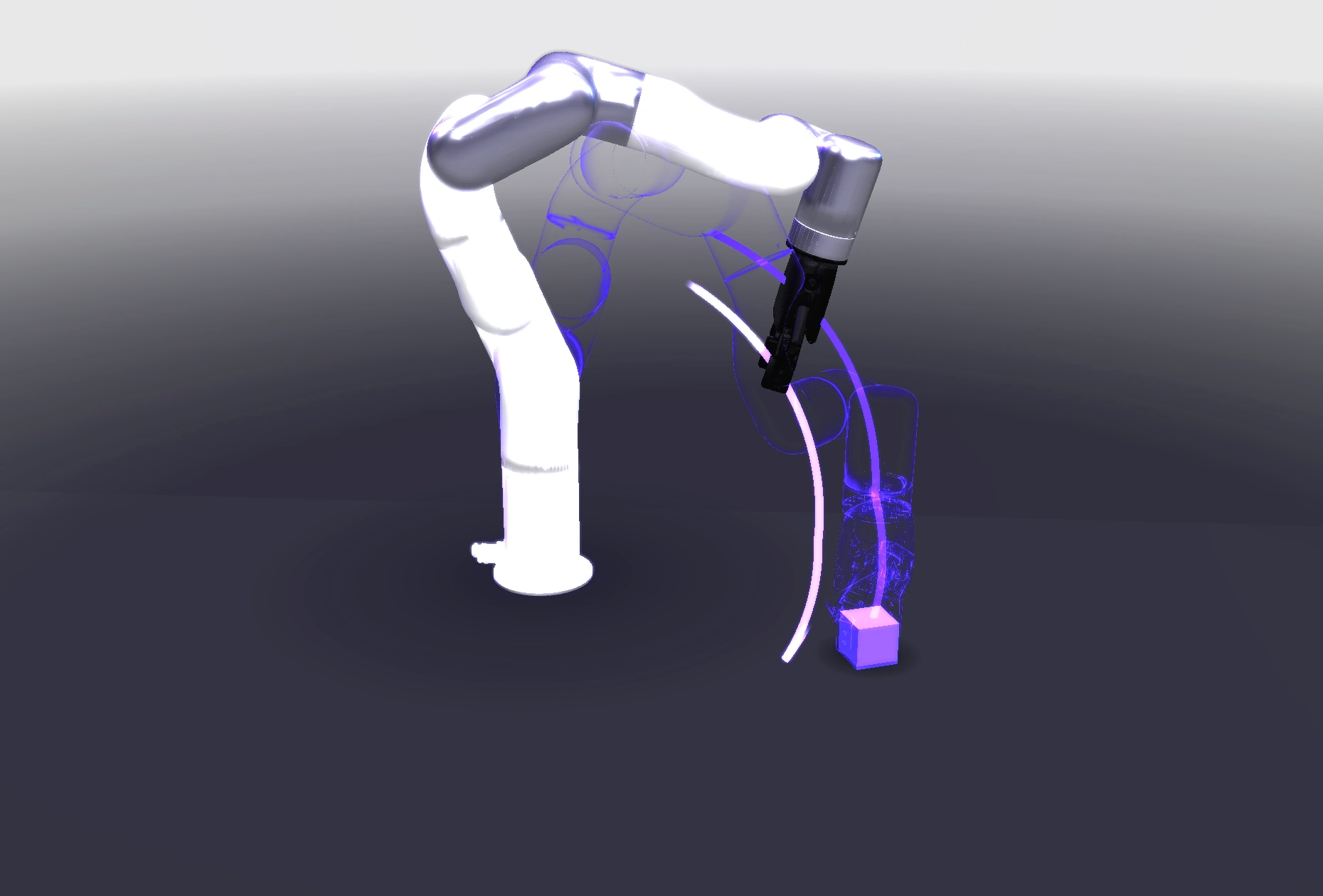
Same policy. Compiled to the body it actually has.

The same intent, recompiled for the machine as it is today, not as it was on paper.

The grasp lands.

Same intent, corrected at runtime for the body it runs on.

LEARN

Every robot makes every robot better.

One unit's correction becomes the whole fleet's head start.

Kyno

The runtime layer for embodied AI.

SCROLL

PROOF · MEASURED IN SIM, 30 TRIALS · EXTERNALLY REPRODUCED

The proof so far.

01 · MEASURED IN SIM

0/30 30/30Grasp success on a drifted body, before and after Kyno.
57.3 5.5 mmGrasp error at the target, before and after.
30/30 · 25/30One intent compiled to two bodies — SO-101 · xArm7.

02 · FOUND IN THE WILD

And it isn't just sim. The drift is already sitting in public data. Nobody was reading the logs.

+1° +2° +3° +4° MsJNeko +3.85° tinkhireeva +2.39° lerobot ◆ +2.31° orsoromeo +2.10° Cornito +2.01° 5hadytru +1.75° ranegray +1.55° armandomm09 +1.50° andlyu +1.46° puneetpanwar +1.27° EverNorif +1.22° youliangtan +1.20° gpudad −0.12° healthy

12 of 13 independent public SO-101 datasets carry a stable positive elbow offset: different authors, different hardware, +1.2° to +3.9°. The marked one (◆) is the LeRobot team's own dataset: +2.31°, trending +0.014° per episode. The arm was drifting while its dataset was being recorded.

WHY NOW

Fleets are coming. Bodies don't stay calibrated.

Robot foundation models are leaving the demo lab. The moment a policy runs on a fleet instead of one pampered robot, per-unit variation stops being a calibration chore and becomes a runtime problem. Cheap arms make it urgent. Expensive robots make it valuable. Humanoids make it existential.

Model vendors already feel it: Ai2's MolmoAct2 ships its SO-101 checkpoints "with calibration correction baked in." A correction frozen into weights is a fleet average: a static answer to a dynamic problem. Per-unit error is invisible in training data by construction, and it never stops. The fix has to live in the runtime loop. Whoever runs that loop owns the execution data that makes robot policies reliable on real bodies.

BUILT FOR FOUNDATION POLICY TEAMS · ROBOT OEMs · FLEET OPERATORS

Have one robot that used to work?
Let Kyno find what changed.

KYNO: THE RUNTIME LAYER FOR EMBODIED AI BUILT BY VLAD MARIAN · @itsvladmarian astrovladmarian@gmail.com